- South Korea's financial regulator has blocked access to crypto exchanges that are not licensed to operate in the country.
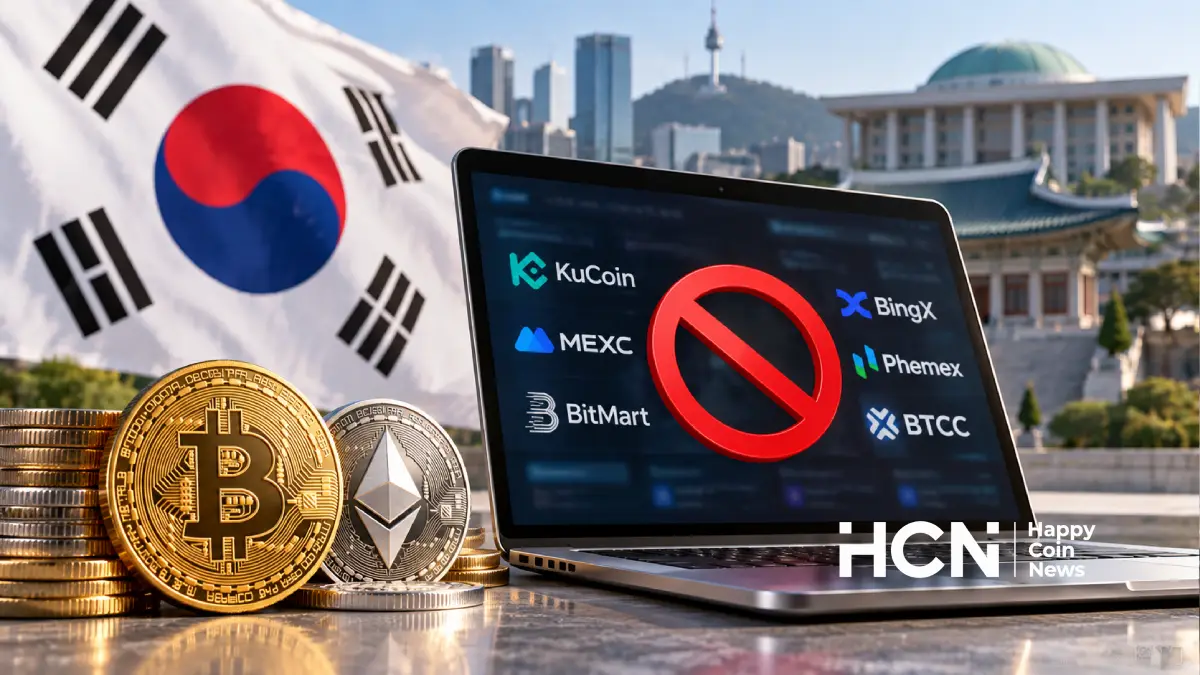
- The list of restrictions includes KuCoin, MEXC, Phemex, Bitrue, CoinW, BTCC, BitMart, BingX and DigiFinex.
South Korea has expanded restrictions against unregistered foreign cryptocurrency services from mobile apps to regular websites. The Financial Intelligence Unit ( hereinafter referred to as the Unit ) reported blocking domestic access to 27 websites of operators that served Korean clients without the required registration. The decisions, at the regulator's request, were approved on October 6 and 7.
Affected platforms include KuCoin, MEXC, Phemex, Bitrue, CoinW, BTCC, BitMart, BingX, and DigiFinex. Websites operating from abroad will be restricted from accessing South Korea, while services with local infrastructure may be shut down.
Korean law requires the registration of foreign virtual asset service providers if they are effectively targeting the local market. When assessing their status, the Division considers, among other factors, the availability of a Korean interface, advertising to local users, and the ability to transact in the Korean won.
Authorities have moved from apps to websites
The current measure closes an access channel that remained after previous restrictions. In 2025, at the regulator's initiative, Google Play restricted new installs and updates of apps from 17 unregistered operators; similar measures later affected 14 apps in the App Store. Now, the blocking extends directly to websites.
The regulator also intends to monitor alternative domains. If an operator attempts to restore access through a new address, additional blocking will be initiated. According to South Korean authorities, materials regarding 44 unregistered operators have already been transferred to law enforcement agencies.
This approach allows for access restrictions to be implemented upon detection of unregistered activity, without waiting for clients to report financial losses. In effect, Korean oversight is shifting from responding to isolated incidents to proactively restricting access to platforms operating outside the local registration regime.
What should clients of blocked exchanges do?
The website's blocking in South Korea does not mean the confiscation of cryptocurrency or the global operation of the exchange itself. However, the Division warned that existing users may face difficulties accessing their accounts and withdrawing assets.
The regulator recommended that clients of unregistered operators withdraw their funds and check the status of their platform. The unit plans to work with the industry association DAXA and the operators themselves to provide asset withdrawal instructions in cases where blocking creates access issues.
Thus, South Korea is not imposing a blanket ban on foreign crypto exchanges, but is increasing pressure on services that serve the local market without registration. For users, the direct consequence is a reduction in access to such platforms and the need to resolve the issue of assets held on them in advance.
The information on this site is for informational and educational purposes only and does not constitute investment advice or financial recommendations. Cryptocurrencies and digital assets carry a high level of risk, including possible loss of capital. The editors are not responsible for decisions made based on the published materials. It is recommended to conduct your own research (DYOR) before making investment decisions. Read the editorial policy at https://happycoin.news/about/