
Economist Ray Dalio predicts a US debt crisis within three years.

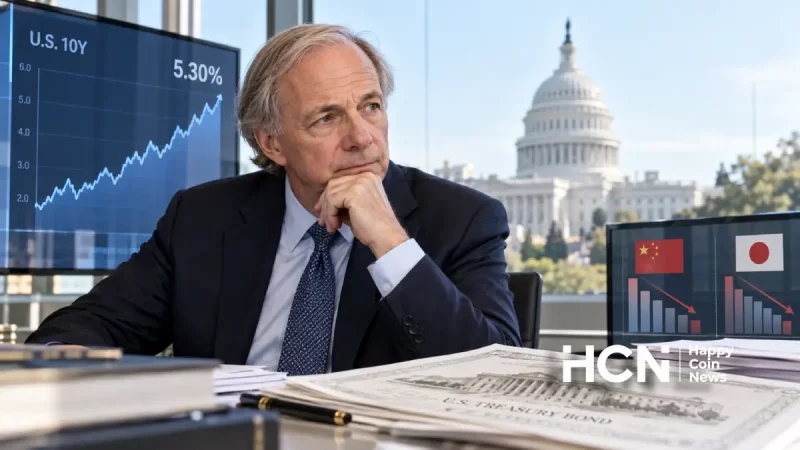
- If current policies continue, Ray Dalio predicts a debt crisis in the US within three years.
- According to the economist, the risks are increased by a decline in demand from China and Japan.
Bridgewater Associates founder Ray Dalio has again warned of risks to the US government debt market. He believes its vulnerability is increasing due to massive new borrowing and declining demand from Japan and China. Meanwhile, yields on 10-year US Treasury bonds have risen to levels seen in the early 2000s.
In an interview with Bloomberg on October 6, Dalio noted that geopolitical and economic factors make further accumulation of US debt less attractive to China.
The Chinese don't want to accumulate further. There are both geopolitical and economic reasons for this, the expert believes.
He also noted that Japan remains the largest foreign holder of US government bonds, but the country has been reducing its positions in recent months.
China and Japan have indeed reduced their portfolios.
The latest available data from the US Treasury Department confirms a decline in both countries' holdings. At the end of July, Japan held $1,104 trillion in Treasury securities, down from $1,117 trillion the previous month. China reduced its portfolio from $633,4 billion to $618 billion.
China now ranks third among foreign holders of US debt, with the UK moving into second place with $998,3 billion. The decline in Chinese investment should be considered a significant trend.
Dalio attributes the Japanese sales to the need to repatriate capital and support financial markets and the yen. In the case of China, he also points to the geopolitical standoff with the United States.
Previously edited Happy Coin News already analyzed the debt crisis model Ray Dalio after his August publication. At the time, the investor outlined the timing of a possible crisis:
My estimate is in three years, plus or minus two, if the current exchange rate does not change.
Dalio added that this timeframe could change due to fiscal policy, wars, and other external factors. Reducing the deficit to approximately 3% of GDP, in his estimation, would significantly reduce the risk.
The yield on 10-year bonds reached 5,31%
According to the US Treasury Department, on October 5, the yield on 10-year government bonds was 5,31%, while the yield on 30-year bonds was 5,66%. Reuters notes that long-term rates are near 24-year highs.
High yields mean more expensive new borrowing and gradually increase the cost of servicing government debt as it is refinanced.
Official budget forecasts also point to a worsening debt trajectory, though they don't predict a crisis within the timeframe outlined by Dalio. The Congressional Budget Office expects a $1,9 trillion deficit in 2026, and estimates public debt held by investors at 101% of GDP. Under current legislation, this figure could reach 120% of GDP by 2036.
The agency's recent calculations also show the budget's sensitivity to interest rates: if they are one percentage point higher than the baseline forecast, the debt could reach 222% of GDP by 2056 instead of 175%.
The AI boom is increasing competition for capital.
Dalio also pointed to the growth of debt financing for artificial intelligence infrastructure. Investments in data centers, computing power, and energy have increased to such an extent that major tech companies are increasingly supplementing their cash flows with borrowed capital.
According to Reuters , Alphabet, Amazon, and Microsoft have issued approximately $220 billion in debt since the beginning of 2026 (more than double the amount issued the previous year). This investment boom has become a factor in the global bond market's pressure, as corporations compete with governments for investor capital.
Dalio believes debt burden is one of the possible mechanisms for correction in the artificial intelligence market: if companies need to allocate increasing amounts of funds to servicing and paying off liabilities, the attractiveness of the most expensive assets could decrease. The expert also cited a tax on large fortunes as a possible trigger.