
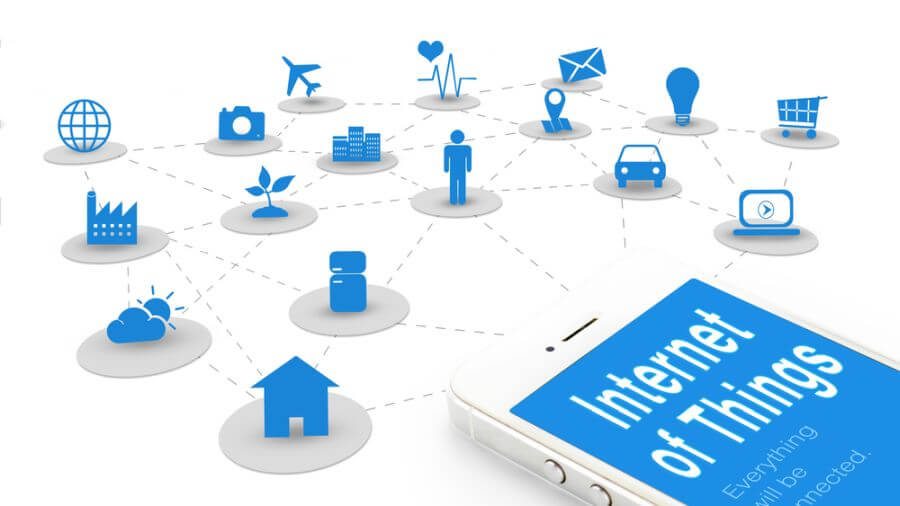
According to the forecasts of the consulting company PwC, the Internet of Things (IoT) can become one of the growth factors of the Russian economy. Experts believe that the “cumulative effect” from the introduction of IoT in the Russian economy will be about 2.8 trillion rubles by 2025.
In particular, the economic effect from the introduction of IoT in the electric power industry will be about 532 billion rubles, in healthcare – 536 billion rubles, in agriculture – 469 billion rubles, in the transport industry – 542 billion rubles.
Thus, in the network energy complex, due to remote monitoring, IoT can strengthen control over substations and power lines.
"As a result, operating and repair costs will be reduced, and technological and commercial losses will be reduced," write PwC experts. "In the power generation sector, IoT will reduce fuel consumption, which currently accounts for more than half of the operating costs of stations. In the transport sector, cars connected to the Internet will reduce operating costs for repairs and maintenance, and the "uberization" of freight transportation will eliminate the need for freight forwarders."
The report names IoT companies as the first among technologies that can change the business model of an entire industry, such as artificial intelligence, robotics, virtual and augmented reality, and blockchain, which can change the business model of an entire industry.
"IoT has significant advantages: it's ready for immediate implementation and has a wide range of applications, " explains Yuri Pukha, head of PwC's IoT Competence Center in Russia. "The infrastructure for IoT already exists—data transmission networks and data storage and processing centers."
The head of the IoT Association, Andrei Kolesnikov, believes that the cumulative effect of the introduction of this technology is underestimated.
"The annual turnover of the housing and utilities sector is 4 trillion rubles, of which 10-20% is due to the lack of transparency in data collection systems and subsequent discrepancies in readings between divisions within the housing and utilities sector . This inefficiency can be eliminated by implementing IoT. The impact, therefore, would reach up to 3.6 trillion rubles by 2025 in the housing and utilities sector alone," he believes.
According to Sergei Skripnikov, a representative of the Internet Initiatives Development Fund (IIDF), the effects of the implementation of IoT are at the intersection of many industries and technologies with strict and long-outdated regulation and established work models.
"Medicine and telemedicine, Big Data and smart cities, transportation and construction, IoT and housing and utilities, IoT and agriculture—these are often gray areas where there are no prohibitions, but also no permits. The main pitfall for IoT is legislation," he notes.
The IIDF representative believes that cybersecurity risks and the lack of industry standards may make large businesses and investors wary of IoT.
"We need to develop legislation, open up frequencies, allow work in new standards, and create incentives for those who launch pilot projects and invest in them," Skripnikov emphasizes.
The information on this site is for informational and educational purposes only and does not constitute investment advice or financial recommendations. Cryptocurrencies and digital assets carry a high level of risk, including possible loss of capital. The editors are not responsible for decisions made based on the published materials. It is recommended to conduct your own research (DYOR) before making investment decisions. Read the editorial policy at https://happycoin.news/about/