Blockchain Solana (SOL), which is often called the "killer" of Ethereum, has become a strong competitor to the brainchild of Vitalik Buterin, so the editorial Happy Coin News I decided to figure out why hedge funds prefer SOL over ETH in 2026.
How much capital was transferred from Ethereum to Solana?
In early January 2026, several media outlets reported on an unnamed analyst who claimed that hedge fund employees were quietly rotating their Ethereum holdings and investing them in Solana . The amount of these transactions was not disclosed, but their scale can be gauged from the ETF market . During four trading sessions from January 7 to 12, ETH-based ETFs lost $346.2 million.
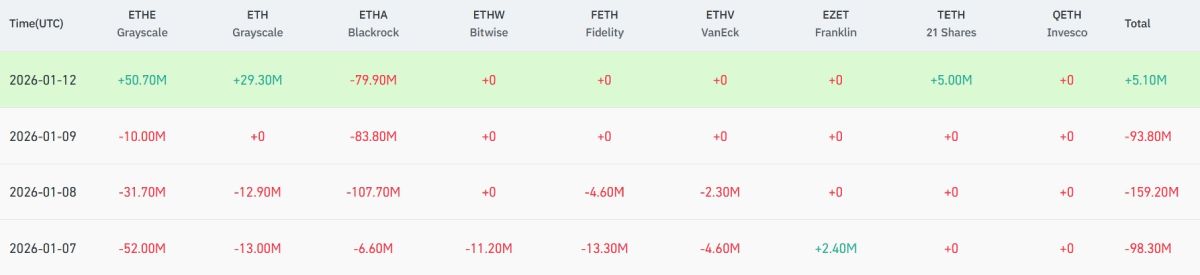
Capital inflows and outflows from US Ethereum ETFs
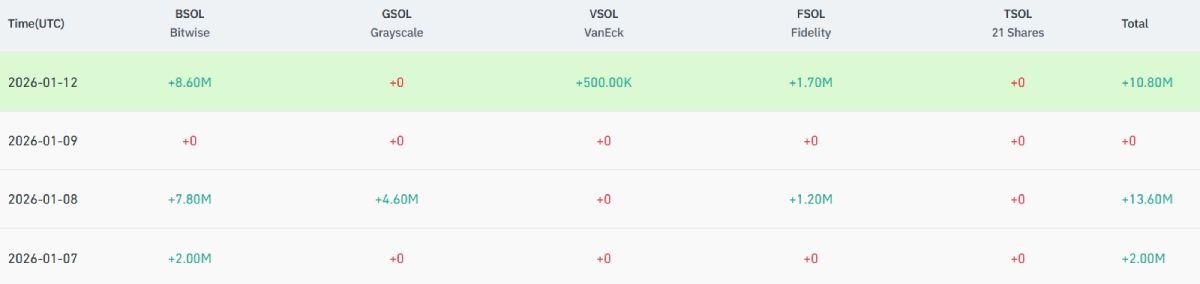
Over the same period, SOL-based ETFs attracted $26,4 million, reaching a market capitalization of $542,4 million. Therefore, it can be assumed that hedge funds rotated capital amounting to several tens of millions of dollars. This figure is indirectly confirmed by the moderate 2,8% increase in Solana's price over the past week. A larger investment would have resulted in a greater price increase.
Why is capital migrating from Ethereum to Solana?
The following factors may have been the reasons for hedge funds to move funds from ETH to SOL:
- The course Solana has a high potential for growth in percentage terms;
- Blockchain Ethereum is becoming too fragmented and complex;
- The SOL network is faster and has lower transaction processing fees.
Solana's market capitalization is almost five times smaller than Ethereum's, so much less investment is needed to increase its price. Consequently, Solana has the potential to appreciate more than ETH during the altcoin season. However, historical data suggests that Solana holders shouldn't get their hopes up. In January 2025, the cryptocurrency's peak was only 13% higher than its November 2021 high, and in September of last year, the digital asset's price fell just 14% short of its all-time high. Therefore, during the next bull run, the price of SOL is unlikely to exceed even $300 and, at best, will rise by 107% from its current value.
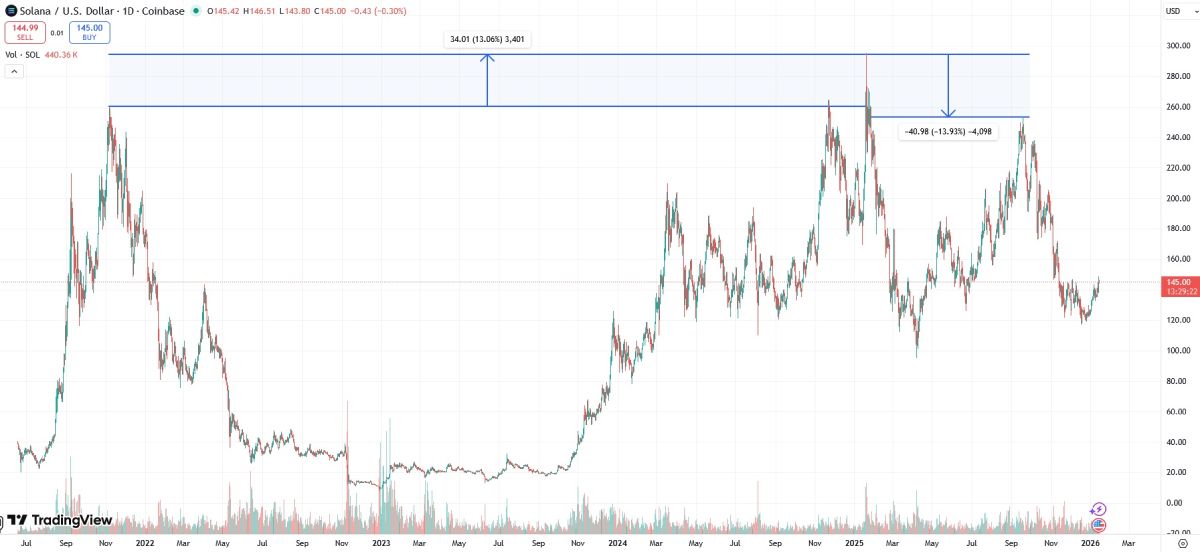
Solana price peaks on the chart
The fragmentation and complexity of the Ethereum blockchain are due to the existence of a large number of second-layer networks and bridges. Second-layer networks have also been launched on the Solana mainnet , but they are far fewer in number, and their necessity is questionable given the lack of scalability requirements for the Solana blockchain. The simpler architecture increases the attractiveness of the Solana network for both developers and users, thus serving as an advantage.
The Solana blockchain's throughput ranges from 2,100 to 4,700 transactions per second, with an average transaction fee of $0,004. The Ethereum network processes no more than 26 transactions per second, with an average transaction fee of $0,2. Accordingly, the Solana mainnet is 131 times faster and 50 times more cost-effective.
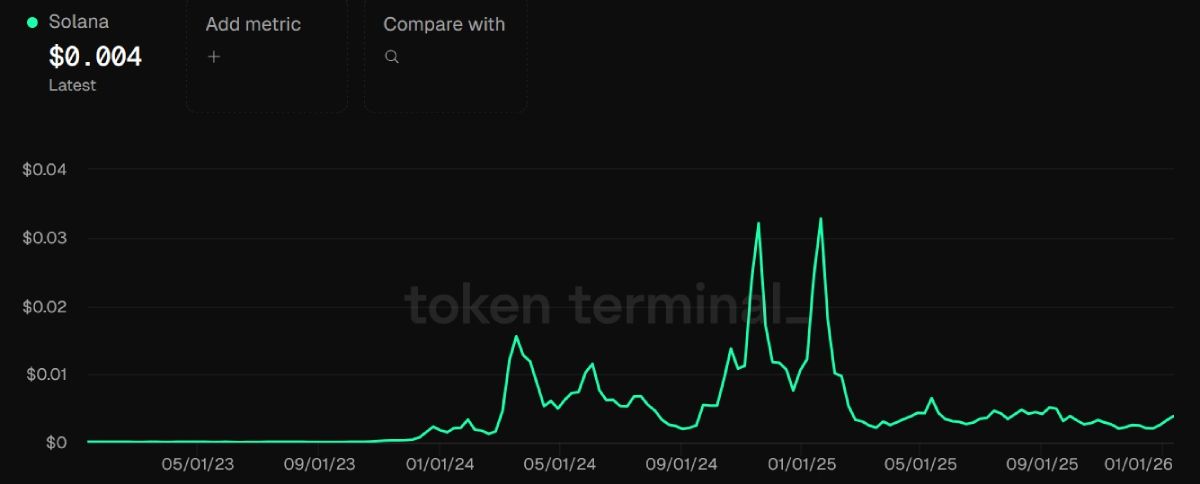
Average transaction fees fluctuate on the Solana blockchain.
Who Wins the Competition: Ethereum or Solana?
The value of cryptocurrency locked in the ETH blockchain reaches $74,77 billion, the lion's share of which is accounted for by liquid staking, restaking, and staking pool protocols such as Aave, Lido Finance, and EigenCloud. The daily trading volume on decentralized exchanges based on the Ethereum network exceeds $1,7 billion, and the value of futures contracts traded within a 24-hour period is $1,3 billion.
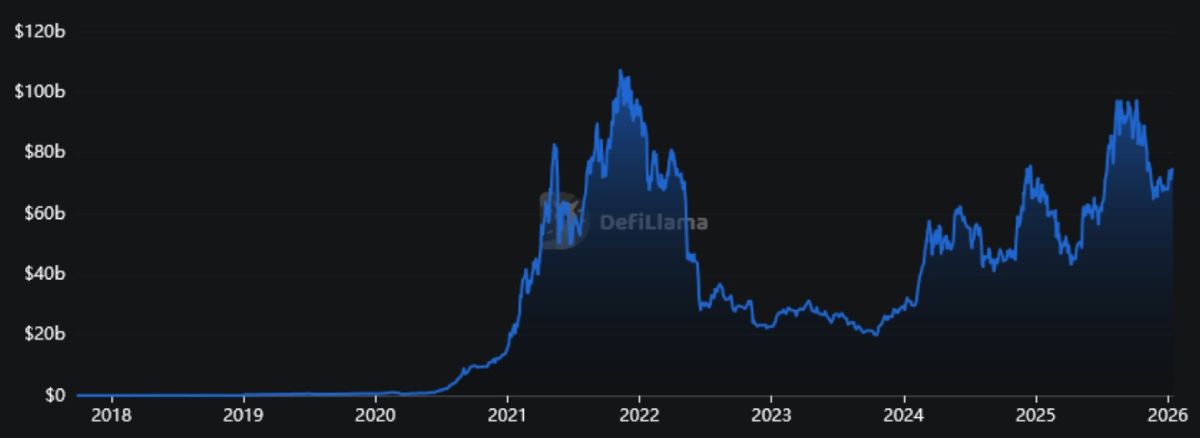
Change in the amount of assets locked in the Ethereum network
The SOL blockchain is more than eight times smaller than the ETH network in terms of the value of virtual currencies locked in DeFi , amounting to only $9,16 billion, despite SOL's higher staking yield. However, in terms of digital asset turnover on decentralized exchanges, reaching $4,38 billion, the SOL network outperforms its competitor by two and a half times due to memecoin transactions. In terms of futures trading volume, estimated at $1,18 billion, the SOL blockchain trails by 9%.
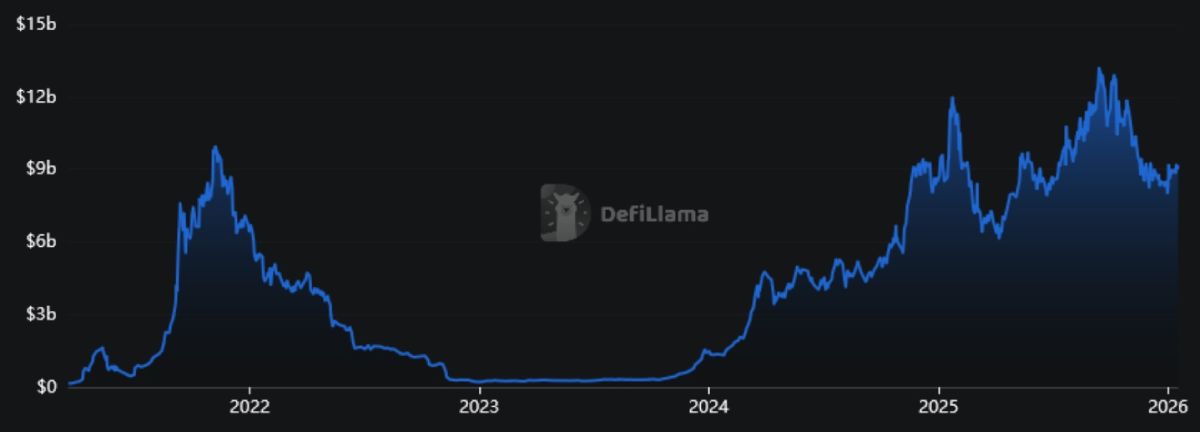
Fluctuations in the value of funds locked in the Solana blockchain
At the same time, the Solana network dominates the memecoin market. Meme tokens issued on this blockchain accounted for 82,1% of trading volume over the past 30 days. BNB Smart Chain came in second with 10,4%, and Ethereum rounded out the top three with 5,6%.
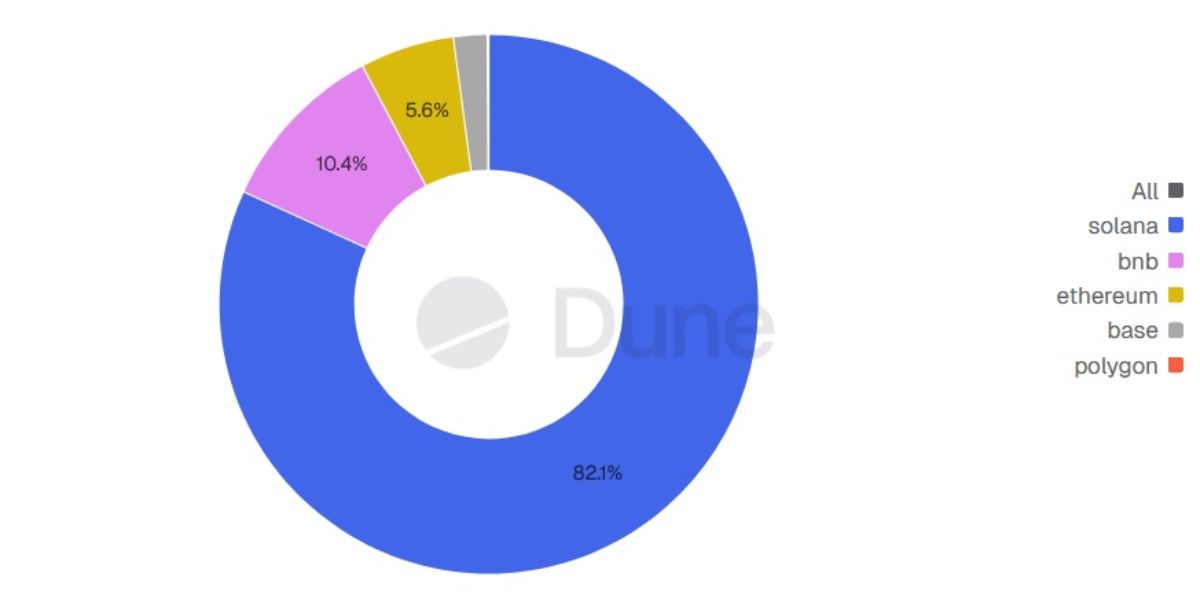
Share of different networks in memecoin trading
Thus, the rivalry between the Ethereum and Solana blockchains is now largely nominal. The networks have carved out their niches in the market, with the ETH mainnet becoming the king of DeFi , and Solana a haven for memecoin creators and traders.
Should I move my investments from Ethereum to Solana?
Over the past year, the value of assets locked in the ETH network has increased by 8%, while memecoin trading volume on the Solana network has declined nearly fourfold over this period due to a decline in demand for meme tokens caused by a series of scandals surrounding fraudulent pump-and-dump schemes perpetrated by issuers of meme-based cryptocurrencies.
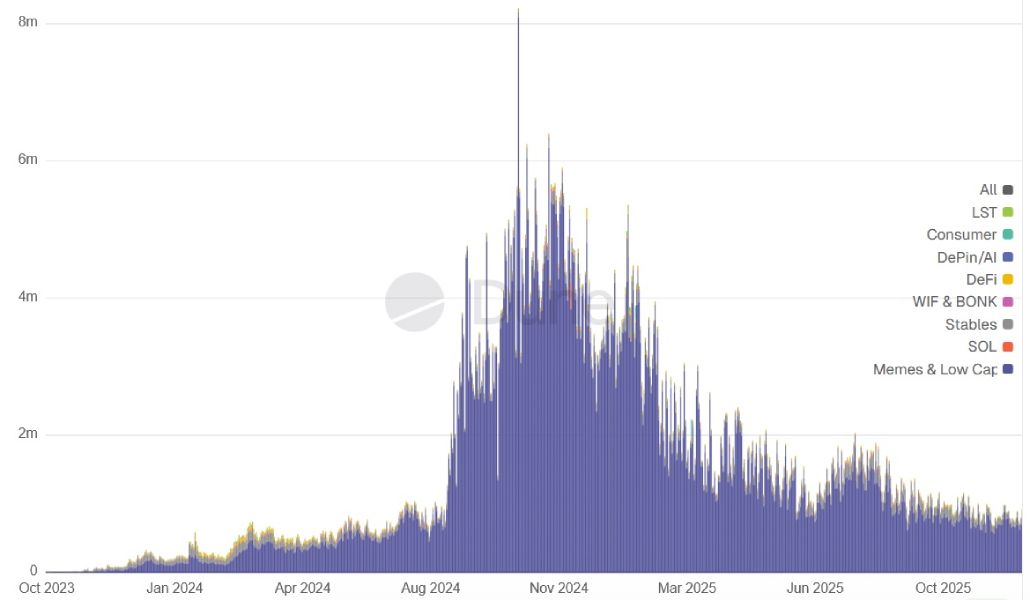
Changes in memcoin trading volume on the SOL network (blue bars)
Bad for blockchain Solana The news is that the meme token market is in a bearish trend and will not return to the peaks reached in October 2024. Meanwhile, decentralized services on the ETH blockchain are attracting capital, so it becomes clear that эфириум has great long-term potential, and there's no point in dumping ETH and investing the proceeds in SOL. Given this fact, the analyst Happy Coin News Yuri Savelyev won't be surprised if the news about the rotation of capital belonging to hedge funds from the Ethereum network Block Solana It turns out to be a hoax launched by cunning traders.
Direct evidence that institutions prefer investing in Ethereum over Solana is the fact that crypto treasury firms have invested 677% more in ETH than in Solana. The value of Ethereum accumulated by publicly traded companies is estimated at $20,2 billion, while the amount of Solana accumulated by firms is only $2,6 billion.
The information on this site is for informational and educational purposes only and does not constitute investment advice or financial recommendations. Cryptocurrencies and digital assets carry a high level of risk, including possible loss of capital. The editors are not responsible for decisions made based on the published materials. It is recommended to conduct your own research (DYOR) before making investment decisions. Read the editorial policy at https://happycoin.news/about/