- Two former Groq engineers believe the terms of the deal with Nvidia are unequal for all investors.
- According to them, in addition to the payments, key Groq employees received additional sums for their transfer to Nvidia.
Two former Groq engineers and shareholders filed a lawsuit in the Delaware Court of Chancery, alleging that the company's $20 billion settlement with Nvidia favored executives and investors associated with them. According to Benjamin Serebrin and Joshua Rubin, some common Groq shareholders received less favorable terms, while key Groq employees also received separate payments for their transfer to Nvidia.
In December 2025, Groq's management announced a non-exclusive licensing agreement with Nvidia for its AI acceleration technology. Groq founder Jonathan Ross, president Sunny Madra, and other employees joined Nvidia, but Groq remained independent and continued operating its cloud service.
Nvidia's financial statements show that the company valued the agreement at $17 billion: $13 billion was paid at closing, with an additional $4 billion to be paid later. Nvidia emphasizes that the tech giant did not acquire Groq shares, existing products, or customer agreements.
According to the Financial Times, approximately $3 billion in Nvidia shares were earmarked for a separate group of Groq employees who transferred to the company, including Jonathan Ross. Together, these amounts valued the deal at approximately $20 billion.
The plaintiffs consider the agreement to be a de facto sale of the business.
Serebrin and Rubin argue that Groq's board of directors should have viewed the transaction not as a simple licensing deal, but as a change of control over a significant portion of the business. The lawsuit states that Nvidia acquired key technology and hired almost the entire Groq engineering team of approximately 200 people.
According to the plaintiffs, the board of directors failed to ensure equal protection of the interests of all shareholders. They also claim that the price received by common stockholders did not reflect the future potential of the technology, while executives and specialists who joined Nvidia received additional benefits.
This is a fundamental legal issue. If a court finds that the transfer of technology and core team is effectively tantamount to a sale of the business, such agreements may be subject to stricter shareholder protection requirements.
After the deal, Groq maintained its value
After the departure of its founder and some engineers, Groq continued its operations. The company focused on cloud infrastructure for running AI models.
In June 2026, it raised $650 million, and in August, another $350 million at a valuation of $3,5 billion. In the second round, Groq announced planned participation from Nvidia. The company also reported operating 13 data centers and serving over six million developers and enterprise customers.
The plaintiffs cite Groq's subsequent valuation as one argument supporting the significant value of the remaining business. However, a direct comparison is hardly valid, as the company changed its business structure after the acquisition and focused on cloud computing.
Groq technology has already been incorporated into Nvidia products.
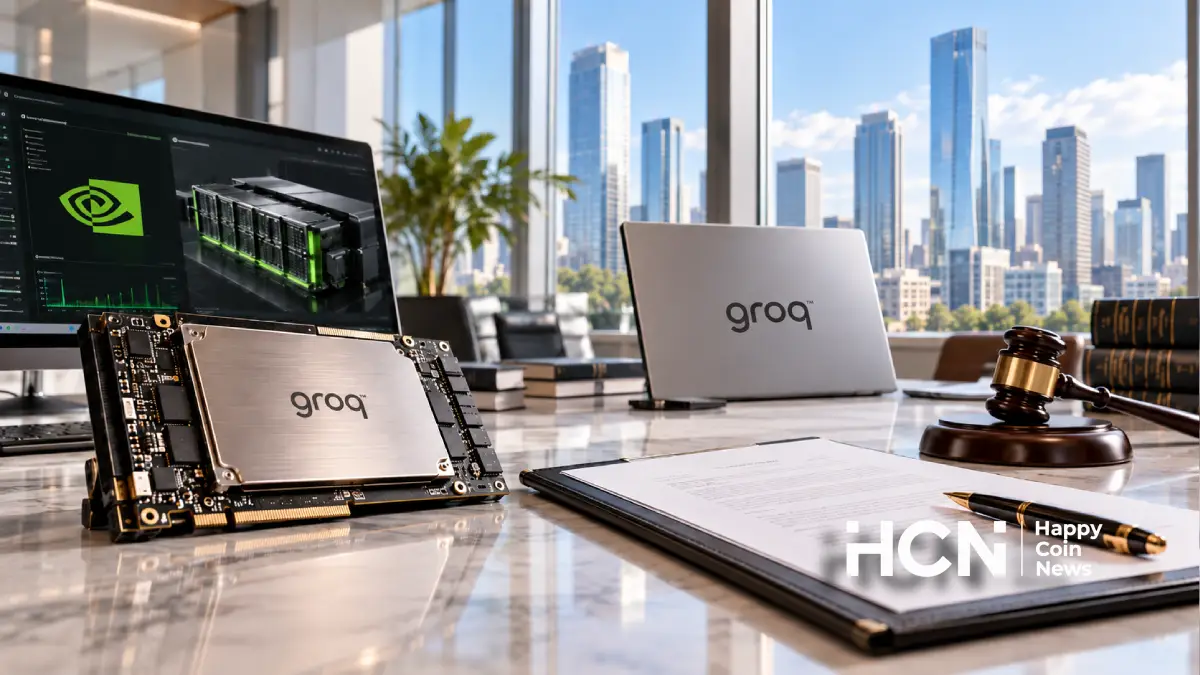
Meanwhile, Nvidia is already using the resulting technology in its products. In its financial statements, the company mentioned the Nvidia Groq 3 LPX accelerator, developed for the Vera Rubin platform and designed for tasks requiring low latency when running AI models.
It turns out that the legal dispute concerns not a future transaction, which can be easily changed, but rather an already implemented technological integration.
The information on this site is for informational and educational purposes only and does not constitute investment advice or financial recommendations. Cryptocurrencies and digital assets carry a high level of risk, including possible loss of capital. The editors are not responsible for decisions made based on the published materials. It is recommended to conduct your own research (DYOR) before making investment decisions. Read the editorial policy at https://happycoin.news/about/