
Hunter Biden's LAPTOP coin lost 90% of its value immediately after launch.


- Memcoin launch Hunter Biden's LAPTOP followed classic pump and dump patterns.
- Immediately after the launch, the token's capitalization soared from $100 billion to $200 billion, and then collapsed to $2-3 billion.
The cryptocurrency market has long been accustomed to extreme volatility, but the recent launch of Hunter Biden's LAPTOP coin set a new record for rapid rise and fall. The token, marketed as a political manifesto, experienced astronomical growth, followed by a swift and devastating collapse.
The coin, issued on the Layer 2 Base network, was created in response to Hunter Biden's attempt to hijack the news cycle surrounding his long-running laptop scandal. Even before the asset began trading on exchanges, the project was subject to harsh criticism.
As we previously reported , the creator had to actively defend his token from attacks from the crypto community on the eve of its official launch. Biden presented this memecoin as a response to the TRUMP token, associated with Donald Trump.
To attract retail traders, the founders promised to distribute up to 20% of the total supply as an airdrop, specifically reserving a portion of the funds for those who suffered losses trading a competitor's coin. Despite these marketing ploys, data from the analytics platform CoinMarketCap shows that the market capitalization of the TRUMP token still significantly exceeds that of LAPTOP, although both assets have lost over 90% of their price peaks to date.
According to market data from DexScreener, the token entered the market with a fully diluted valuation of just over $100 billion. Within the first few minutes of trading, this figure soared, surpassing the $200 billion mark. However, the triumph lasted only seconds, after which the asset plummeted by more than 90%, and its valuation fell to $2-3 billion.
The project's fundamental problems were obvious even before the first orders were executed. The research platform Bubblemaps warned early on of the colossal concentration of supply in the hands of a small circle of insiders. An analysis of smart contracts revealed that the founders' wallets, fund reserves, liquidity pools, and airdrop addresses controlled nearly 90% of the entire supply. Meanwhile, Hunter Biden and his team held approximately 30% of the total asset supply.
This structure has raised legitimate concerns among investors about a potential exit scam and uncontrolled dumping of coins on inexperienced retail buyers.

Source: Bubblemaps
Extreme volatility led to a colossal redistribution of capital in just a few hours. According to analysts at Onchain Lens, one lucky trader managed to earn over $1 million. He purchased 9,120 LAPTOP tokens for $249,000 at the very beginning of trading and sold them shortly after for $1,2 million.
Other market participants suffered catastrophic losses. According to blockchain researchers Lookonchain, another investor risked $200,000 by purchasing 919 tokens at the incredibly inflated price of $218 per share. After the price collapsed, the value of his position was reduced to $3,000.
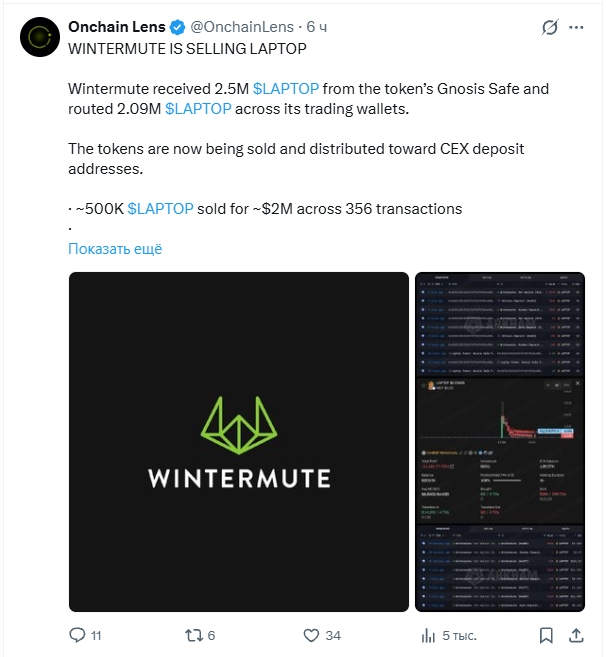
Selling pressure has intensified manifold due to the actions of large institutional players who rushed to lock in profits.
Onchain Lens data indicates that well-known cryptocurrency market maker Wintermute launched a massive sell-off of assets as their value plummeted. After receiving 2,5 million LAPTOP tokens, the market maker sold 500,000 coins for $2 million in 356 separate transactions, simultaneously sending the assets to deposit addresses on major exchanges such as Kraken, Gate, and KuCoin. This flood of liquidity from insiders and professional market participants was the main reason for the rapid price collapse.
The launch of the LAPTOP coin serves as a textbook example of the high risks inherent in the political cryptocurrency segment. The use of big names and promises of generous airdrops often serve as a veneer for projects with unfair tokenomics, where insiders and large market makers reap the brunt of the profits.