- The Bank of Russia's inclusion of organizations in the register of crypto exchangers automatically makes them subject to EU sanctions.
- The sanctions apply exclusively to legal entities and do not apply to individuals or their cryptocurrencies.
The Bank of Russia has begun allowing organizations officially engaged in digital currency exchange to enter the market. On October 9, the regulator added My Bitcoin LLC to the relevant register and confirmed the company's authorization to conduct such activities.
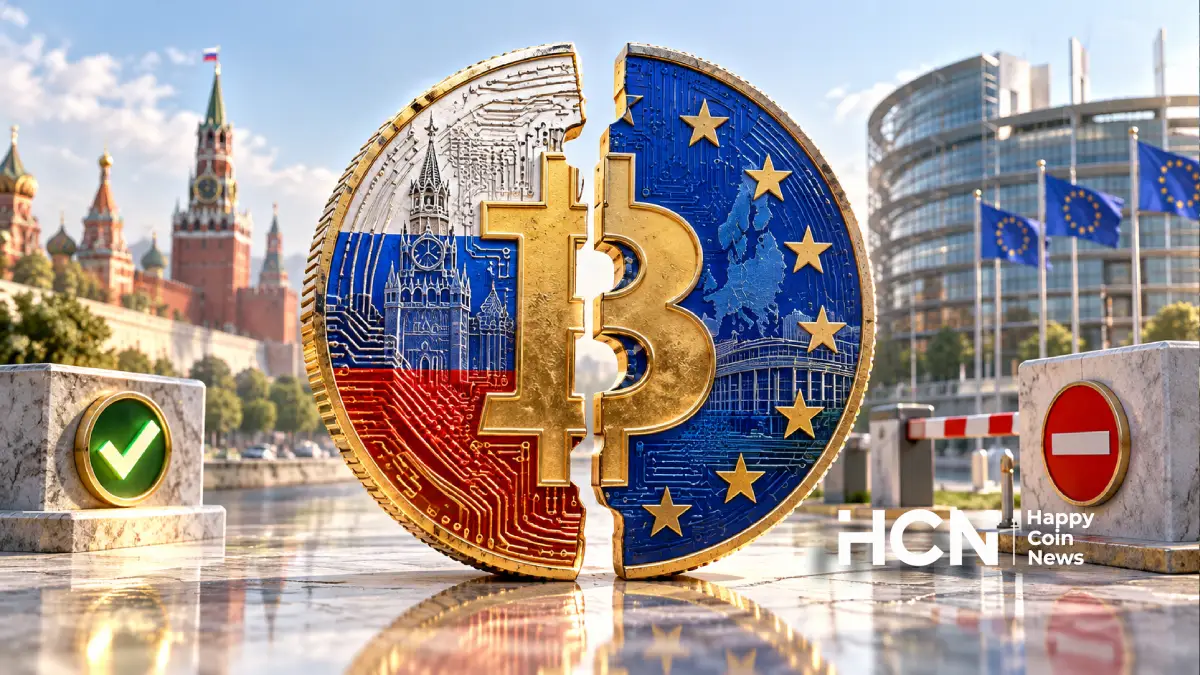
For the Russian market, this status signifies the transition of crypto exchanges to a regulated environment. However, outside of Russia, this same legal status creates a different problem: starting May 24, 2026, the European Union will ban transactions with crypto service providers and crypto asset exchange or transfer platforms established in Russia. This ban does not require each company to be individually included on a specific sanctions list.
What does inclusion in the Bank of Russia register mean?
According to the Central Bank of the Russian Federation, organizations that exchange digital currencies systematically buy and sell cryptocurrency in their own name and at their own expense to individuals and legal entities. Such a participant must be a Russian business entity and meet capital, management, and infrastructure requirements. The primary and backup software and hardware systems must be located in Russia.
Regulation also increases transparency. Federal Law No. 282-FZ requires crypto exchanges to store information about clients, transactions, and operations, the parties involved, digital accounts, and identifiers used for at least ten years, as well as to create backup copies of this data.
In essence, a regulated exchange creates a long-term connection between the client, the transaction, and the crypto address used. For oversight and the prevention of illegal transactions, such transparency is part of the new market model.
Why does the EU operate in reverse logic?
Back in the spring, the European Union changed its approach to Russian crypto infrastructure. Previously, sanctions could be applied to individual platforms. For example, the new EU regulation explicitly mentions Garantex, which was added to the sanctions list in 2025.
European legislators then explained the expansion of the measures by citing the possibility of transferring the activities of certain restricted services to new Russian entities, for which purpose Article 5bb was added to Regulation No. 833/2014 . It prohibits direct or indirect transactions with a legal entity or organization that provides cryptoasset services or operates a platform for their exchange or transfer and is incorporated in Russia. The ban is effective May 24, 2026, and contains several specific exceptions.
The EU Council calls the new measure a "complete sectoral ban" on Russian providers and platforms that facilitate the transfer and exchange of crypto assets.
My Bitcoin LLC is a legal entity registered in Russia, officially authorized by the Bank of Russia to engage in digital currency exchange. According to Article 5bb, the company is classified as a Russian cryptocurrency provider, transactions with which are prohibited for individuals and organizations covered by the European regulation. This is a conclusion drawn from the company's status and the text of the regulation, and not a separate EU sanctions decision against My Bitcoin.
The exchanger's client does not become a sanctioned person
It's important to draw a line here that wasn't clearly outlined in the initial discussions. Using a Russian-regulated exchange service does not, in itself, place the client on the EU sanctions list.
Article 5bb prohibits transactions with a certain category of Russian organizations. It does not contain a provision that would automatically make their clients sanctioned persons or freeze their personal wallets.
In addition, the EU sanctions regulation has a specific jurisdictional scope: it applies within the territory of the Union, to citizens of EU member states regardless of their location, to companies established under the laws of EU member states, as well as to businesses fully or partially conducted within the territory of the Union.
Accordingly, a Russian user's transaction through an exchanger registered in Russia does not constitute personal sanctions against that user.
Another question arises: what happens if the direct counterparty of a Russian crypto exchange is a European exchange, custodian, financial company, or other entity obligated to comply with Regulation No. 833/2014? For them, Article 5bb already has direct application.
At the same time, the text of the regulations does not allow for another common conclusion: that any cryptocurrency that has ever passed through a Russian exchange automatically becomes a "sanctioned coin." Article 5bb does not establish such a rule. The extent to which previous transaction history will serve as grounds for additional verification or denial of service will depend, among other things, on the sanctions and compliance policies of the specific foreign service.
The information on this site is for informational and educational purposes only and does not constitute investment advice or financial recommendations. Cryptocurrencies and digital assets carry a high level of risk, including possible loss of capital. The editors are not responsible for decisions made based on the published materials. It is recommended to conduct your own research (DYOR) before making investment decisions. Read the editorial policy at https://happycoin.news/about/