- US inflation exceeding expected levels has forced investors to withdraw capital from risky assets.
- The reason is that risky assets have become less profitable compared to US Treasury bonds.
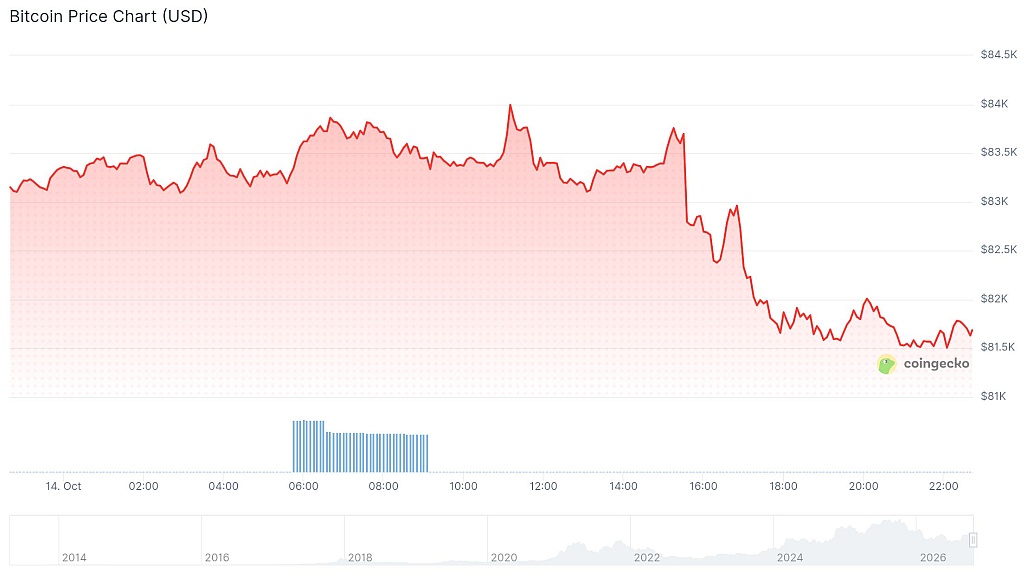
On October 14, Bitcoin fell below $82,000 amid higher-than-expected inflation in the US and a revision of the Federal Reserve's rate hike expectations. By the evening, BTC was trading at approximately $81,850, down about 1,6% in 24 hours.
The cryptocurrency's decline coincided with a shift away from risky assets as US Treasury yields rose, the dollar strengthened, and the US stock market came under pressure.
Source: CoinGecko
Core inflation was higher than forecast
According to the official report from the US Bureau of Labor Statistics, the consumer price index in September rose 0,6% month-on-month and 3,7% year-on-year, following a 3,4% increase in August. Gasoline prices accounted for more than half of the monthly increase, rising 9,1%.
However, core inflation, which excludes food and energy, proved more important for the market. It rose by 0,3% month-on-month and 2,6% year-on-year, compared to economists surveyed by Reuters who had expected 0,2% and 2,5%. Inflation Insights founder Omair Sharif noted that the unexpected price pressure was spread across several categories, rather than concentrated in a single component.
This complicates the argument that the acceleration in the consumer price index is solely due to a temporary jump in fuel costs.
The probability of a rate hike has risen sharply.
The Federal Reserve already raised its rate in September to 3,75-4,00%. Before the new report, the market had largely expected the regulator to pause at its meeting on October 27-28. After the release of the Consumer Price Index, rate futures began pricing the likelihood of another hike at approximately 50%.
The decision is far from predetermined. Fed Vice Chair for Supervision Michelle Bowman stated that the regulator may wait and assess the impact of the September rate hike on the economy and financial markets.
For Bitcoin, changing expectations are important due to the cost of capital. A higher implied rate typically supports US government bond yields and the dollar, while reducing the appeal of risky assets. This is precisely the combination observed after the CPI: US stocks declined, while the dollar and bond yields rose.
Bitcoin is back near $81,500.
During October 14, the price of BTC hesitated from $81,500 to $84,024. The market thus again approached the area where significant liquidation of long positions occurred the day before. the editors noted Happy Coin News, the previous move through $81,500–82,500 has already partially cleared this area of leveraged buyers.
Currently, pressure on Bitcoin is linked not only to the market's internal structure but also to a reassessment of US monetary policy. While investors are open to the possibility of another Fed rate hike, high bond yields and a strong dollar remain an unfavorable macro backdrop for BTC and other risky assets.
The information on this site is for informational and educational purposes only and does not constitute investment advice or financial recommendations. Cryptocurrencies and digital assets carry a high level of risk, including possible loss of capital. The editors are not responsible for decisions made based on the published materials. It is recommended to conduct your own research (DYOR) before making investment decisions. Read the editorial policy at https://happycoin.news/about/