
5 universal laws of human stupidity that an investor should know


An Italian professor formulated the basic laws of human stupidity. But they are ideally applicable to investments as well.
In 1976, a professor of economic history at the University of California at Berkeley published an article in which he formulated the fundamental laws of what he considered to be the greatest threat to human existence: Stupidity.
According to Carlo Cipolla, stupid people can be identified by several characteristic features:
- a lot of them;
- they lack common sense;
- they create problems for others without obvious benefit to themselves.
As a consequence, stupidity reduces the overall welfare of society, and there is no effective defense against it.
Cipolla writes: “There is only one way for a society not to fall under the yoke of idiots: people with common sense must work even harder to compensate for the damage caused by their stupid brothers.”
Let's look at the five basic laws of human stupidity and try to understand how they apply to investing and the market.
Law #1: We always underestimate the number of fools around us.
“No matter how you estimate the number of idiots around you, the reality will inevitably turn out to be even more cruel,” writes Cipolla.
In investing, the problem of investor stupidity is compounded by the human tendency to make biased assumptions. When reading a publication in the media, we make a conclusion about the author’s competence based on superficial factors, such as his place of work, level of education, etc. At the same time, we are more willing to trust his opinion if it coincides with our own. This is one of the basic cognitive distortions - “the tendency to confirm one’s point of view.”
If we believe that the stock market will rise, we unconsciously look for news and information that would confirm our opinion and ignore other facts. This cognitive distortion becomes the main motive for investment behavior for many.
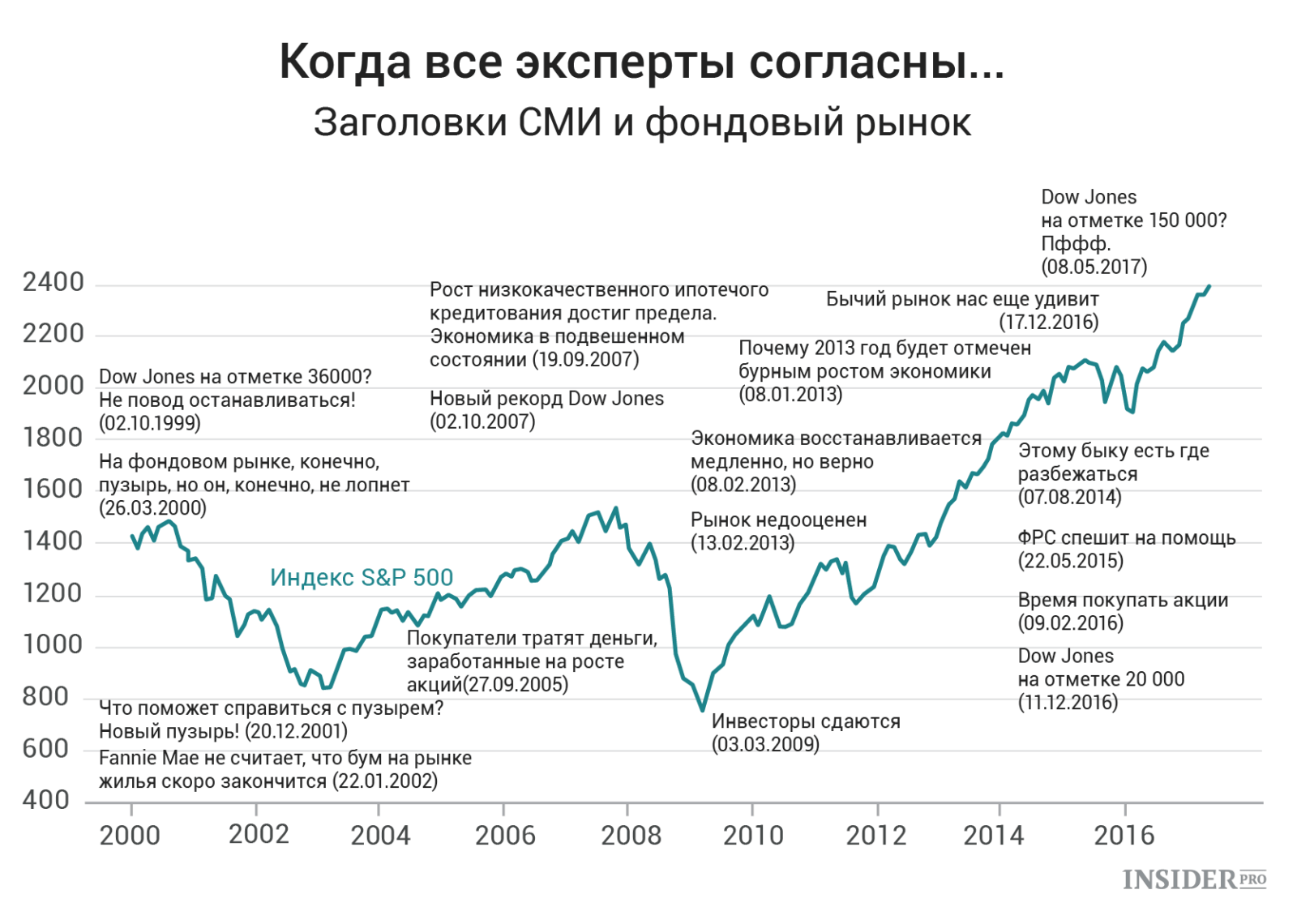 As thinking beings, we seek confirmation that our current thought processes are “correct.” As humans, we hate being told we're wrong, so we tend to only pay attention to sources that tell us we're right.
This is why it is always important to listen to both sides in any dispute with an open mind and analyze the data accordingly. Only then will your “rightness” really allow you to make money.
Law No. 2: The likelihood that a person is stupid does not depend on any of his other qualities.
Cipolla argues that stupidity is a quantity that is constant in all human societies. Whatever separate category we take - gender, race, nationality, education, income level - the percentage of fools in it will be the same.
In relation to investments, this means that ALL investors, private and professional, are prone to making “stupid” decisions. Analysts note:
“At every major market peak throughout history, there has always been something that has been perceived as a speculative investment.” Whether it was railroads, real estate, emerging markets, technology stocks or tulip bulbs, the scenario was always the same: first, investors rushed headlong into these markets, only to then panic and try to sell everything. Today, as the chart below shows, exchange-traded funds have taken on this role.
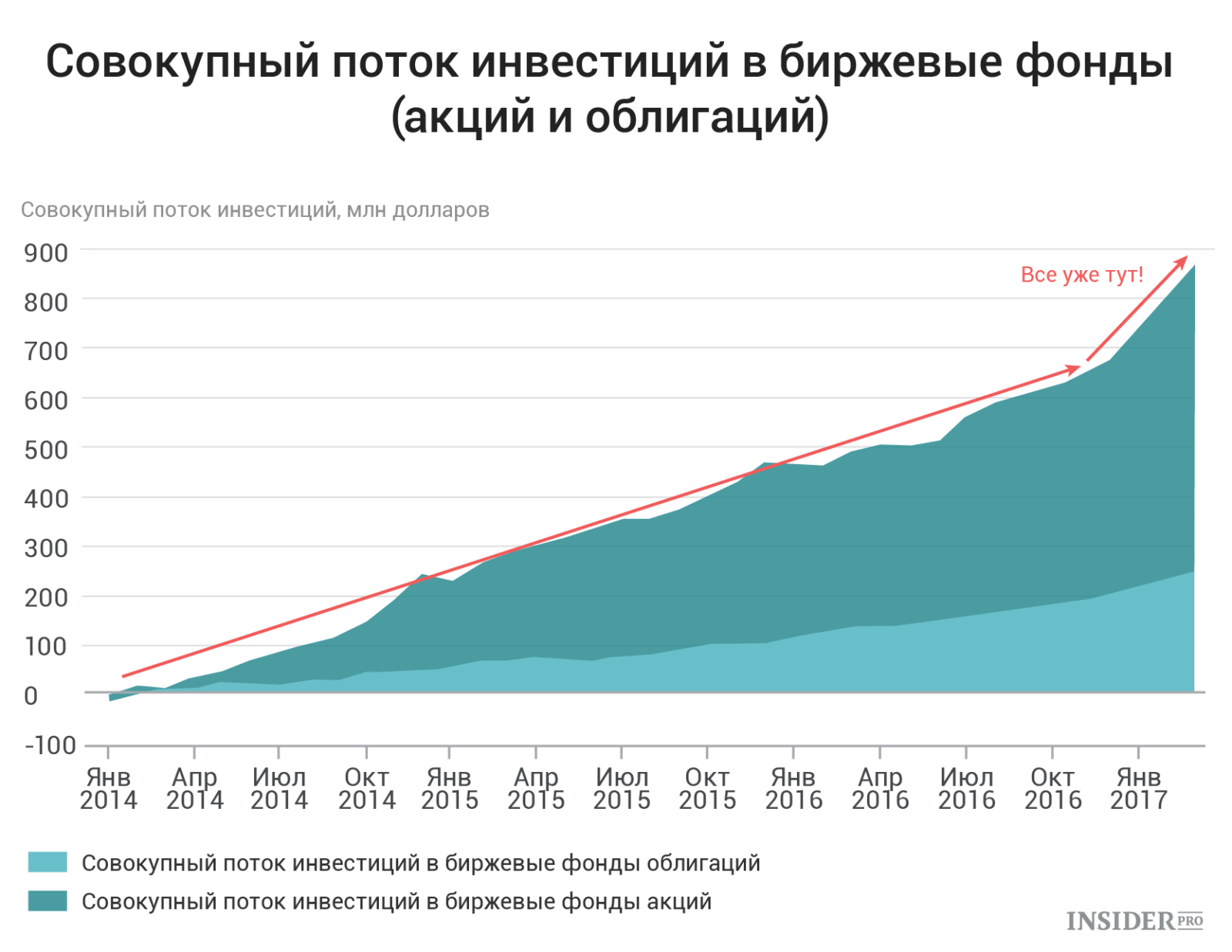 It is not the rise in capital flows into exchange-traded funds itself that should cause concern, but the “human factor” behind it.
Although we rarely realize it, people tend to “follow the crowd.” To a greater extent, this behavior is associated with the same cognitive distortion, and to a slightly lesser extent with the desire for social approval. It is very deeply ingrained in us that if “everyone else” is doing something, then I need to do the same or risk being an outcast.
In life, such “conformity to the norm” is socially acceptable and in many ways useful. However, in financial markets, herd behavior leads to too sharp and unjustified market rises and declines. As Howard Marks once said:
“Resisting a mob—and especially successful resistance—is not easy. What makes it difficult is the combination of many factors, including natural herd instincts and the inevitable damage that comes with the first attempts to get out of a rut. The law of conservation of momentum invariably leads to the fact that for some time the actions of the crowd seem to be the only correct ones (which is why it is important to remember that “being too ahead of time is the same as making a mistake”). The future is uncertain, so it's hard to be sure you're right, especially if the market is moving against you right now."
But it is the ability to not follow the crowd that brings investors the greatest returns in the long run. Unfortunately, most of us have a hard time understanding who exactly is wrong and when to bet against them.
Law #3: A fool is a person whose actions cause harm to another person or group of people. At the same time, he does not receive any benefit, and may even incur losses.
Consistency of stupidity is the only thing in which a fool is consistent. And this is what makes stupid people so dangerous.
Cipolla explains: “In essence, stupid people are dangerous and harmful because it is difficult for intelligent people to understand and predict behavior that is not based on common sense.”
Investors are constantly drawn into investment strategies offered by a wide range of “industry professionals”, which ultimately leads them to losses.
Jason Zweig said it well in his recent article, “Don't Read This Column”: “Investors believe some very strange things. As a recent survey showed, wealthy investors on average predict an inflation-adjusted return of 8,5% per annum for their portfolios. Let's say bonds make up about 2,5% of the portfolio; then, to achieve such a goal, shares would need to rise by 12,5%. And if you take into account fees and inflation, it turns out that to provide such a return, the growth rate of shares should be approximately twice the 7% that is actually observed in the long term.
Moreover, it is not just individual investors who have such strange ideas. Another survey found that one in six institutional investors forecast returns on their venture capital investments of more than 20% annually, although venture capital investments lagged the stock market for much of the 2000s.
Although virtually nothing is impossible in financial markets, these expectations are so far-fetched that they border on fantasy.”
He's absolutely right. Moreover, contrary to historical realities, both private and professional investors are likely to suffer losses. As the chart below shows, there is no evidence that markets will be able to maintain high growth rates at current valuation levels.
There is a huge difference between AVERAGE and ACTUAL return on invested capital. In any given year, losses significantly undermine the average annual return.
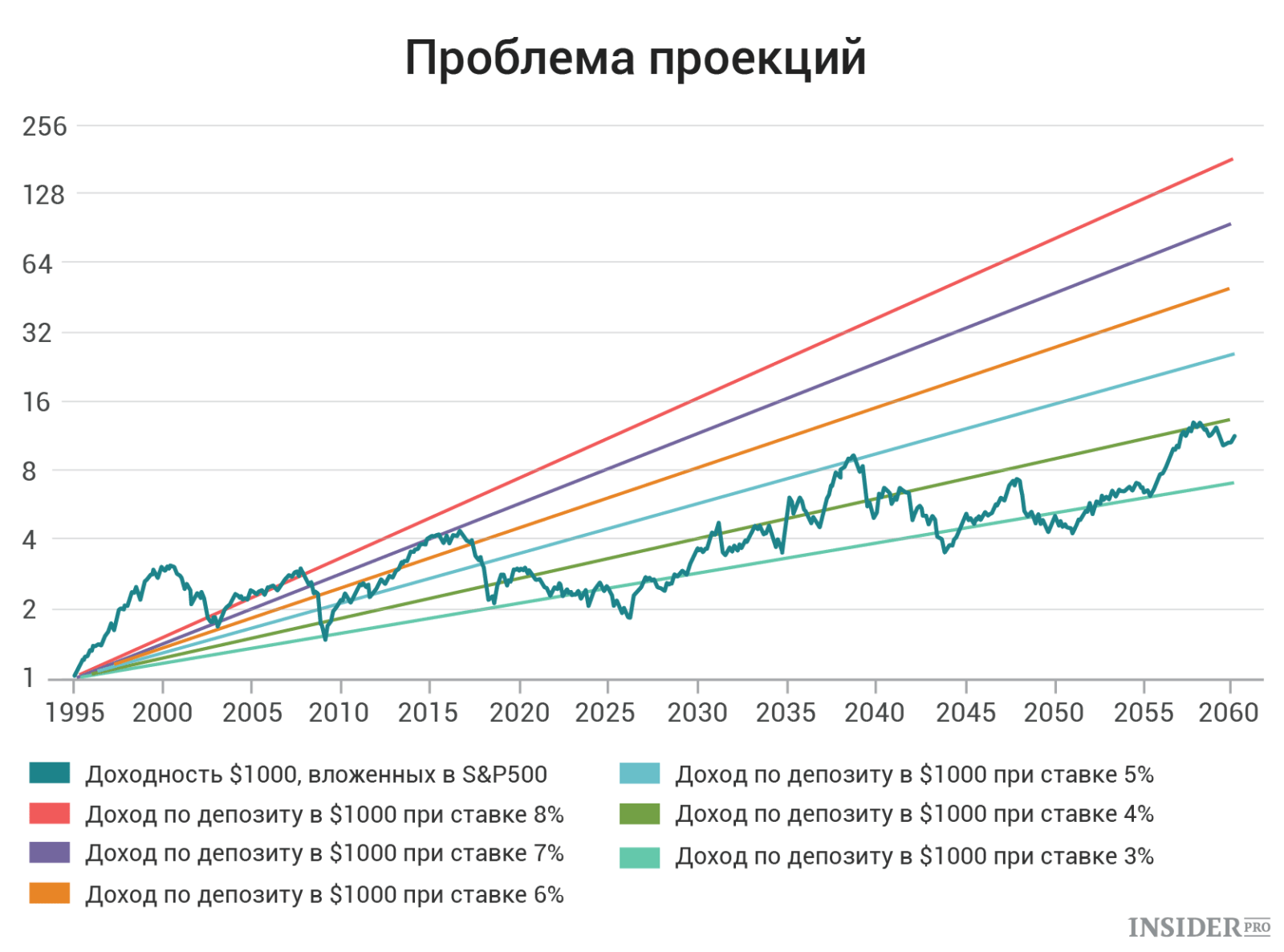
Individual investors who have lived through one or two of the last bear markets are well aware of how much timing can make achieving your investment goals. Those who were preparing to retire in 2000 or 2007 and were unable to cope with the market decline had to postpone their retirement - and perhaps indefinitely.
And now, just eight short years after the biggest financial crisis since the Great Depression, people are boldly taking risks again because “this time is different.”
What else can be said about stupidity after this?
Contrary to constant media pressure, investors should simply “passively invest in indexes”, forgetting about the actual risk management.
But the reality is that investors continue to “buy high and sell low”—and for good reason. “Greed and fear influence our investment decisions much more than logic and discipline.”
Jason states, “Optimism and overconfidence encourage us to believe in the investment tooth fairy who will leave money under your pillow. Hope is eternal, and each of us believes that we are better than other investors. But there’s another reason why many investors believe in magic: we don’t dare accept reality.”
All this brings us to the fourth law.
Law No. 4: Smart people always underestimate the damage caused by stupid people. In particular, they constantly forget that any contact with those who completely lack common sense will always and under any circumstances turn out to be a costly mistake.
Many people with common sense now assume that the next correction will be mild, most likely no more than 20%. Their assessment is based on the belief that the US Federal Reserve and central banks in developed countries will respond quickly to the downturn and that investors will not delay their return to the market.
However, as we have repeatedly observed, in moments of crisis, stupid people tend to do the exact opposite of what sensible people expect of them.
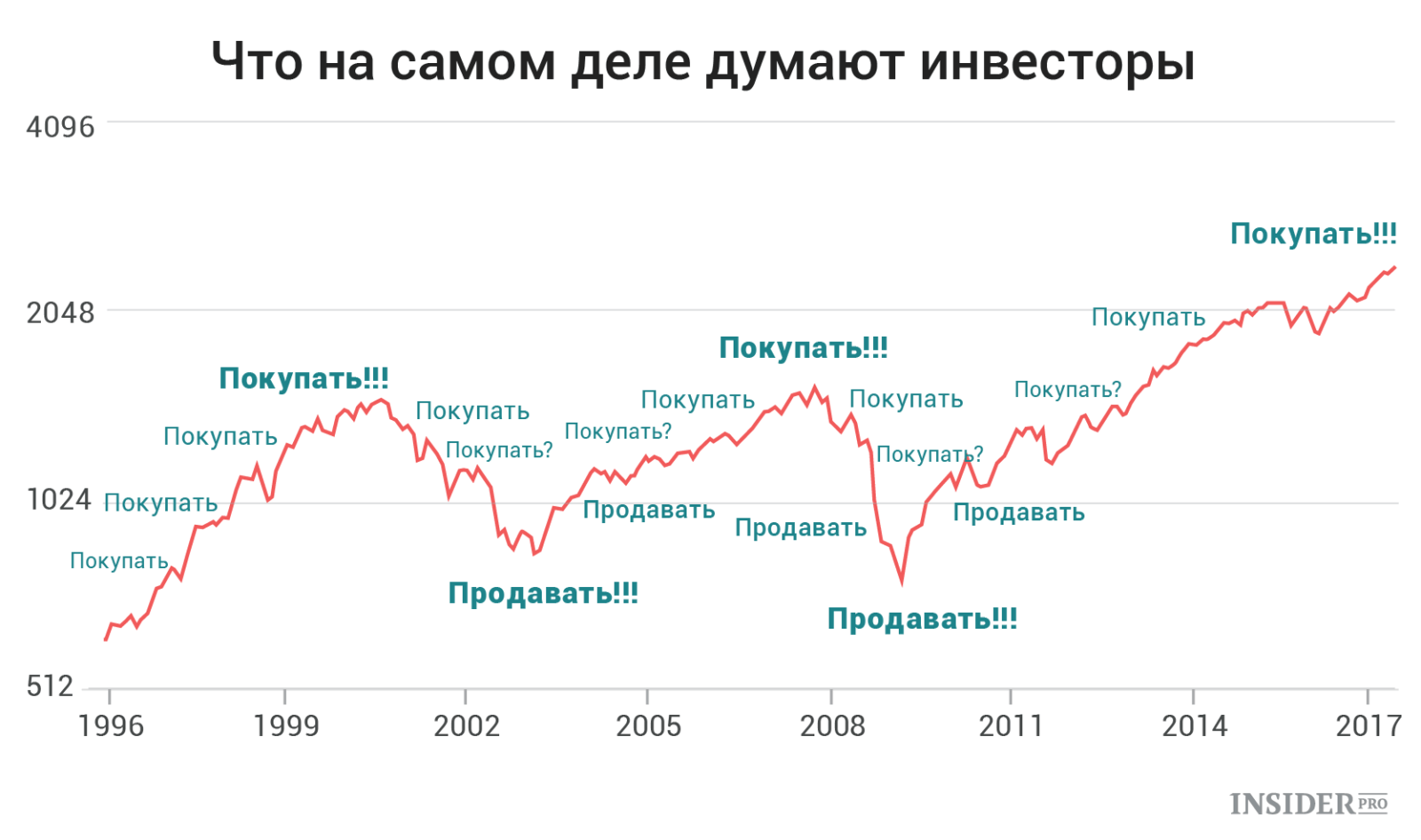 Take, for example, the eternal bulls who keep telling investors: “Hang in there, keep investing, you're a long-term investor, aren't you?” Such “experts” never notice the coming bear market until it is completely established, and then they simply say something like “oh well, no one could have expected this.”
Sane people are conservative. They analyze the risk of loss and preserve capital during market declines. Make sure you surround yourself with people who understand what you are doing. As Howard Marks said, sometimes a person walking against a crowd feels lonely.
By underestimating stupidity, we take great risks.
And finally, the fifth and final law.
Law No. 5: A stupid person is the most dangerous.
Herd behavior inevitably ends badly for investors. There are always those who believe that for one reason or another this time everything will be different.
Will not be. It has never happened like this, and “this time” is no different from the others.
However, great investors have always been characterized by the ability to act independently of the crowd, guided by discipline, strategy and will.
They don't buy and hold.
They buy low and sell high. They avoid losses at all costs and have a deep understanding of the relationship between risk and reward.
They think clearly.
You should follow them, and not those who shout at you from the screens, ordering you to “buy, buy, buy.”
Savvy investors don't spend most of their time waiting for a recovery after a correction. This strategy is best left to the crowd.
Source: insider.pro